Author: kjhendren
C’Mon People

Any way this thing could have been built to last? How about not having the thinnest cast section go through the area of highest stress.
The Shoe Shiner
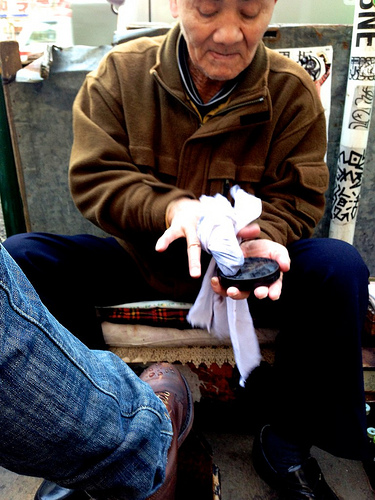
As a person that designs goods, and quasi-luxury goods at that, I’ve been feeling myself pulled constantly towards a need to possess nicer things. The desire is persistent, from the things I wear, to the things I use, to the things I plan to acquire next. For clothing, I used to shop at thrift shops—a veritable Mackelmore in my hayday. With an increasingly busy life, I traded the luxury of disposable time for the luxury of disposable income. So, of course, I started shopping at Target. And H&M. But lately, I’ve had a hankering for Zara shirts, and Muji everything. Is this creeping materialism, or growing up…or is it both? But I had today a mild epiphany on the corner of a street in Tokyo, something which I hope to keep oft in mind. There was about an hour left before my train to the airport, and I was headed back to pick up my things from the hotel, when I noticed a mild old man sitting astride a shoe shine box near the subway exit. Now, I’ve never had a shoe shine, and I wasn’t even sure my old dirty boots would quality. Walking over towards him, I drew up my pant legs and gave the universal shoulder/eyebrow sign for “well?” He gestured over towards a yellow laminated sign and gave the universal sign for “got this much?” Taking my seat and pulling up my first boot, I watched the man gingerly apply polish with an old toothbruth, and then proceed to spend ten minutes rigorously polishing each boot. The time spent was enough to make me apprehensive about my train, but was also ripe for reflection. I thought of the lovely patina acquired by leather, and how I appreciate that the layers of polish were in a way a travel momento: in many years time, the boots would have the world’s diversity engrained in them. I thought about the care he gave to my lowly boots, and the importance of not disparaging lesser customers. And then I noticed the shoes the man had on. In a city like Tokyo, the opulence of which is probably matched by only a few other metropoli worldwide, this man must have seen the entire range of footwear: from my lowly Fryes, to the $10,000 (insert-famous-fashion-label). And yet the man wore a pair of black leather slip-ons. They were suple and well polished, but their age was coming through at the edges. Now I know it’s nieve to assume the man had the means to acquire shoes of higher calibre, but some part of me expected that. And it made me think: if this humble man, who sees daily extravegance–if he is content to appreciate the nicer things in life without necessarily posessing them, then perhaps there’s something for me to learn from him. He also did a damn fine job on the boots, which was nice.
The Right Stuff
Just finished Tom Wolfe’s “The Right Stuff”, about the early days of flight test pilots and the beginning of NASA’s space program. Really interesting treatise on the fraternity of pilots, or more-so, the extreme levels of competition between them–all seeking to reside at the top of the pyramid, to receive universal acknowledge of their stuff (right), and to pathologically avoid being left behind by their peers. I had a few major take-aways. First, people can achieve great things when their actions are motivated by passion and not renumeration. It was surprising to hear how lean were the living standards of our early pilots, and how little they cared. Second, missions in life need to be specific, ambitious, and time-framed. See: Kennedy’s challenge to put a man on the moon by the end of the decade, and return him safely to earth. I wonder how much more I would accomplish if I applied these traits to the constant flow of ethereal, formless dreams meandering through my thoughts. Finally, on the books title, I wondered what the corollary to the pilot’s “right stuff” would be in the design world. For aviators, it’s a constant cool under intense pressure, improvisation in novel scenarios, the ability to push the edge of technology’s capability, and the aura of control where it may not exist. Yup, that about does it.
Such Considerate Taggers

Look Twice
The first step after bus boarding–for me, and everyone else it seems–is to scan all the way to the back for one of the rare and coveted open rows: two whole seats to oneself for the long city to south bay commute. If with luck obtained, each subsequent stop becomes an inverse beauty contest, as we all brave the Hunger Gamesean odds at keeping our solitude. Losers frown or mutter with resentment. Winners count down anxiously until the last city stop. But on this rainy day, already resigning myself to share a space, I plop down next to a guy with an iPad (less elbow than typers). Shortly into the ride, though, I look up a row to notice an open window seat, and then with disdain at the guy next to it. He has pulled a very serious bus foul: taking the aisle seat first, artificially increasing his solo odds by making the widow seat a confrontation away. The position is fortified by miscellaneous items strewn about the open space. And I realize that every time we come to a stop, he slowly begins to organize these things. FIrst, folding the jacket carefully, checking pockets and such. Then the laptop is closed gingerly and finds its way into a bag whose fascinating contents must also be surveyed. The coffee cup gets adjusted in its holder. And just as this rigamarole concludes, as he looks up to magnanimously offer his open seat–just at this moment–the driver shuts the doors and pulls away. What I perceive to be this false generosity–this is even more infuriating than the first offense. So I seethe for a while, then my mind eventually wanders onto better ways to make windshield wipers or why the rain gutters don’t more adroitly channel excess flow. But somehow in this time I perceive something else. I perceive that this guy ahead of me is sick. As in bronchial, crumpled soggy kleenex, drippy nose, take something, get-that-checked-out sick. And I wonder if he may not be doing us all a solid by going solitary, at least putting up a little buffer–the contextual equivalent of not shaking hands. This reminds me that things are not always as they seem, and maybe people generally deserve the benefit of a doubt. Unless he’s faking it.
Isolation
A Central American sunrise this morning, revealed through the thin windows of a low haze that reminds me more of mist than fog. Walking to my bus stop, there are surprisingly few people or sounds in the streets. Until off in the distance I hear the wail of a siren call out–the sound that most oft punctuates city life, and speaks in undulating sorrow. Across the street, while a woman exchanges numbers with an ATM, the toy terrier at her feet turns his head aloft and howls in tune with the ambulance. Seeing this domestic creature, so unlike its ancestral wolf in moonlight, but nonetheless taking hold of those roots, gives me a smile, and I look around for one to share it with. But the man on the bench wears headphones, and doesn’t hear. So too with the woman. Smile unshared, I walk on and reach the line for the bus where, moments later, a couple yet amidst the evening’s inebriation stumble forth. “What’s this?” they ask to a man with white earbuds and downturned eyes. Then the next. Then the next. I tell them we’re on our way to work, though my answer is met with disbelief and a colorful proposition. As the bus pulls up, and we begin to board, the woman yells after me, “nah, have fun at the casino you guys!” I smile, and look up at a bus full of headphones.
Humanity

We’re a funny lot. Love it when people interact with their environments for no other purpose than to satisfy their own humor.
Sometimes
Sometimes as you’re listening to a song, you can be surprised to find out that absolutely everything else has become right in the world. Things slow around you in elegance, they fall into a Godly rhythm and gain nobility and worthwhile purpose. You catch here the edge of a smile, there the twinkle of an eye. You notice peoples’ hands more. And you begin to wonder how it was that you ever came to live without this song. How anything could have ever been good or true that was not played to this melody or laid against this backdrop. And then in three or four minutes—if you’re lucky five—the song comes to an end. Life re-complicates, it disassembles itself right there in your hands. War and famine ensue, heroes fall, cameras flash. Your senses ring in the conspicuous absence. And you begin to wonder how it was that things ever seemed so good. How they will ever be that way again… Sometimes that happens.
DMV
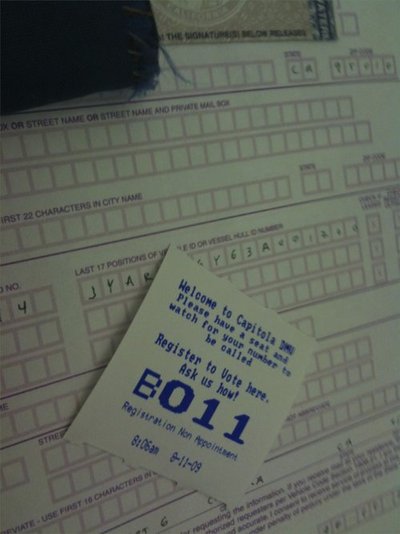
I show up 3 minutes after the doors open, and stilL get B011— about a 30 minute wait by my estimate. If one were to take wagures, they’d never guess that the department of motor vehicles would welcome the most interesting people in the world. But it does. In walks the guy who’s probably a volunteer soccer coach, with his worn in kangaroo leather shoes and tight buzz cut. His hands are thick and worn in the fashion of a day laborer. He’s followed by a chain wearing couple whose clothing motif seems to revolve around skulls. I wonder what would bring such hoodlums to so ordinary a venue. And they begin to sign elegantly to each other with a comfortable familiarity and tenderness. I wonder what this experience is like for someone who cannot hear the constant drone and repetition of call numbers, or the light sasfarilla of Michael Bolton in the background. These details make me feel a deep heavy feeling, that might be love mingled with sadness for the difficulty of so many lives. I could also just be hungry, because it’s quite early. The guy behind window 9 waves whenever someone is called to his station, a slow mixing motion that reminds me of pagaentry. I think he likes when his window is called. “now serving B zero one one”, at window number 4.
 kjhendren